Start with the money you can actually lose
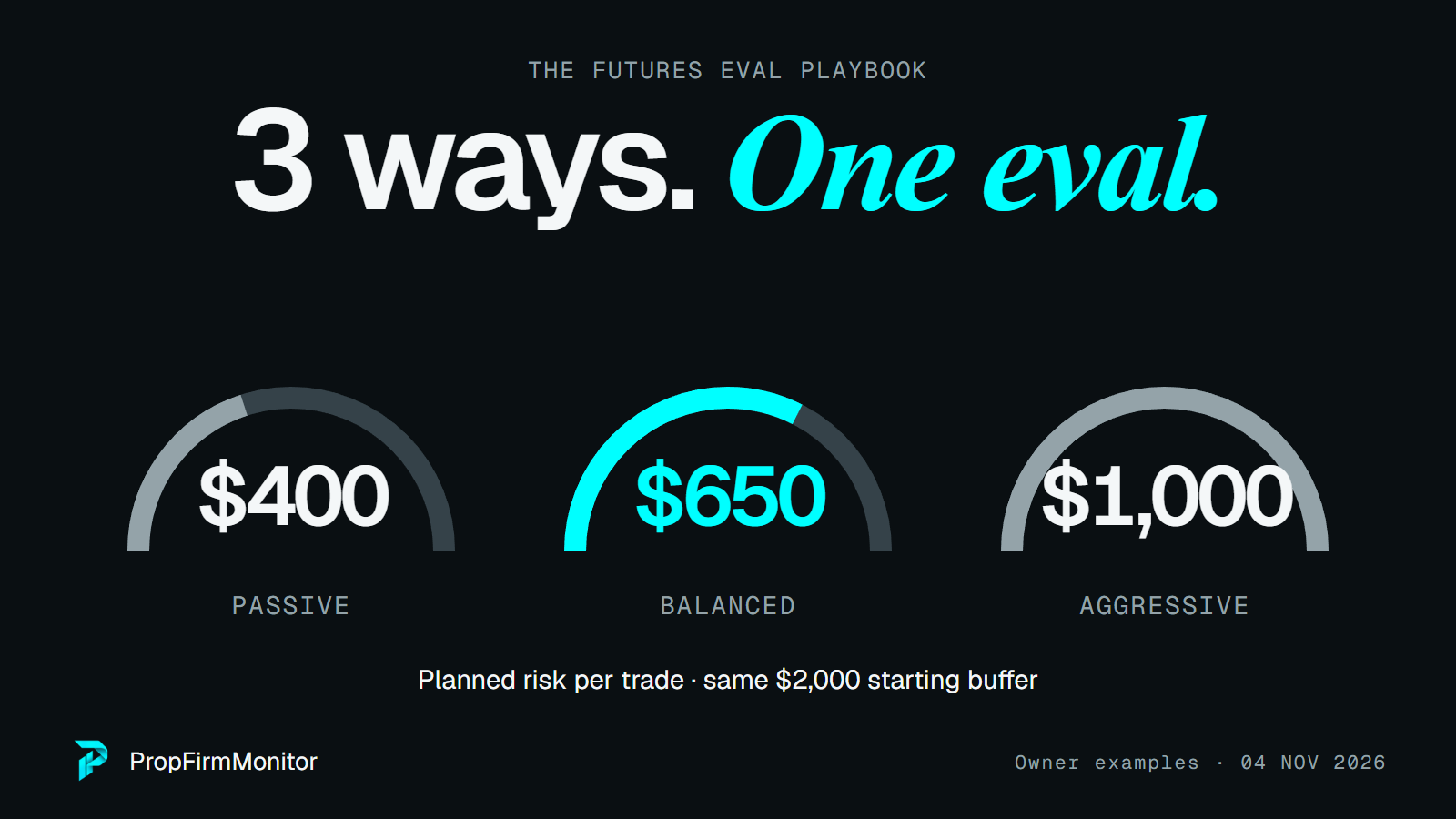
Your loss buffer sets the pace. I compare $400, $650 and $1,000 risk so you can fit a passive, balanced or aggressive approach to the actual plan before trading.
A $50K futures evaluation is a paid trading test using simulated funds. The account name tells you its starting balance. It does not mean you can lose that whole amount. The loss limit is the number that matters for this plan. A loss floor is the balance level your account must stay above.
I like the $50K because several plans give you a $3,000 target against a $2,000 loss buffer. The target is 1.5 times that buffer. You can compare the sizes in the size guide. That advantage depends on the plan; it is not a rule for the whole market.
- Example profit target
- $3,000
- Example starting loss buffer
- $2,000
- Target divided by buffer
- 1.5×
Here are three approaches, from passive to aggressive, plus the full-risk version I do not recommend. They keep the same starting target and buffer, but use different real plans so the rules fit. None of the paths is a result or a promise.
Match the approach to the actual plan
Rules below are as of November 2026, checked on 4 November. DLL means daily loss limit, a cap on how much you can lose in one day. Select the named options. A firm's cheapest headline price may come with different rules.
| Approach | Selected plan | Eval consistency | Daily loss limit |
|---|---|---|---|
| Passive | Blue Guardian Reserve with 40% option, no DLL | 40% | None selected |
| Balanced | Alpha Futures Standard | 50% | None in evaluation |
| Aggressive | FundedNext Rapid Pro without DLL add-on | None | None selected |
These examples each have a $3,000 target and $2,000 maximum loss. Funded rules change: Alpha Standard and Rapid Pro apply 40% consistency when funded. Blue Guardian Reserve has no funded consistency rule. Passing an eval and becoming eligible for a payout are separate steps.
Passive: one good trade a day
An A+ setup is a trade that meets your own highest-quality entry rules. It is not a setup you invent because the account needs profit. A consistency rule limits how much of your net profit can come from your best trading day.
At 40%, you need at least three profitable days. Two days cannot each stay within that share and still make up the total. For the passive approach, divide the starting buffer into five slices: $2,000 divided by five is $400 of planned risk per trade.

R means the amount you plan to risk on one trade. At $400 risk, 2.5R is a $1,000 winner before costs. Take one trade a day, and aim for that reward only if the chart gives you room. If an obvious price level blocks the target, follow your plan or skip it.
| Path | Quick maths | Total |
|---|---|---|
| Three wins | 3 × $1,000 | $3,000 |
| Three wins, two losses | 3 × $1,000 − 2 × $400 | $2,200 |
| Four wins, two losses | 4 × $1,000 − 2 × $400 | $3,200 |
With two losses along the way, three wins leave you short. A fourth win takes the arithmetic above target. That is six trades in total, so the five slices are a starting risk budget, not a five-trade deadline.
Balanced: enough room without babying the account
This is the approach I like most. Use Alpha Futures Standard for the real 50% example. Its evaluation has no daily loss guard, a two-day minimum and a $3,000 target. Its loss floor trails at the end of the day and locks at the starting balance.
Give the starting account roughly three chances. $2,000 divided by three is about $667, so I round risk down to $650. Three losses use $1,950 before costs. That leaves only $50, so it is not room for another full-size trade.

That leaves just $3 above the target before costs. If combined costs exceed $3, you are short. Check your actual net profit and best-day share on the dashboard. Unequal fees can also make one day slightly more than half, even when the gross wins match.
If one $650 loss sits between two wins, the gross total is $2,353. Another equal winner takes it to $3,854.50. Do not force that trade just because you feel close. The consistency guide walks through both plans and the effect of a losing day.
Aggressive: more risk, fewer chances
The matching example is FundedNext Rapid Pro without the daily-loss add-on. It allows a one-day evaluation finish and has no evaluation consistency rule. Its $50K contract cap is four minis or forty micros. Your stop distance and contract size must fit that cap.
Start with $1,000 planned risk on an A+ setup. A 3R winner makes $3,000 before costs. If the chart offers only 2R, take the $2,000. You are then $1,000 away from the gross target.
If another A+ setup appears that day, my next step risks $1,000 for a 1R winner. If it loses instead, you remain $1,000 up before costs. A $51,000 end-of-day close moves this plan's loss floor to $49,000, leaving $2,000 of room at that point.
A later $1,000 risk trade winning 2R would bring total gross profit to $3,000. The trade-path guide shows the branches and the floor. Net profit still has to clear the target, and the firm still reviews the account.
Full port: the version I do not recommend
Full port means putting the whole available loss buffer at risk on one trade. At $2,000 risk, a 1.5R win makes $3,000 before costs. A full loss reaches the starting $48,000 floor and ends the account. Costs can make that happen sooner.
The arithmetic needs a one-day plan with no evaluation consistency rule and no daily loss limit. Rapid Pro without the add-on matches those headline conditions, but that does not establish that an all-in strategy is permitted. Firm conduct rules still apply. Two possible outcomes also do not mean equal odds.
My pick, and what to check before trading
I recommend the balanced way most. You do not have to baby the account, and the planned risk is below the aggressive version. Choose it because the rules and your experience fit, rather than because a neat table suggests a finishing date.
- Do not take a lower-quality setup because it is “only an eval.” Those habits can follow you into the funded stage.
- Do not stretch a target past an obvious level just to hit a chosen R multiple.
- Check the active loss floor, net costs, contract cap and any personal restrictions before entering.
- Read the funded rules again after passing; evaluation freedom does not carry over automatically.
Compare $50K challenges, use the consistency calculator for actual net days, and budget attempts with the funding cost tool. Firm profiles: Blue Guardian Futures, FundedNext Futures and Alpha Futures. Always manage your risk. Take care!
Test the same record in different trade orders. The companion math series separates model results from actual firm rules.
Official sources
- Blue Guardian Futures Reserve rulesOfficial source · checked
- Blue Guardian Futures pricing and selected optionsOfficial source · checked
- Alpha Futures Standard rulesOfficial source · checked
- Alpha Futures consistency rulesOfficial source · checked
- Alpha Futures pricing and minimum trading daysOfficial source · checked
- Alpha Futures maximum loss limitOfficial source · checked
- FundedNext Futures Rapid Pro evaluation rulesOfficial source · checked
- FundedNext Futures Rapid Pro funded rulesOfficial source · checked
- FundedNext Futures loss-limit calculationOfficial source · checked
- FundedNext Futures prohibited strategiesOfficial source · checked
- FundedNext Futures Disciplined Trader ProgramOfficial source · checked
This is education, not financial advice. Rules change; check the firm's current terms before you trade.
