Use the right plan before reading the paths
One loss can end your account. FundedNext Rapid Pro has a four-mini cap at $50K, and the clean full-buffer example still needs fees, the live floor and conduct rules checked.
My aggressive example starts with a $50K evaluation, a $3,000 profit target and a $2,000 maximum loss. It needs no evaluation consistency rule and a one-day finish to be possible. Use FundedNext Rapid Pro without the daily-loss add-on for the matching rule set.
As of November 2026, checked on 4 November, that configuration has no daily loss limit. It has a four-mini or forty-micro contract cap at $50K. The cap still matters: the contracts and stop distance must fit both the dollar risk and the plan limit.
A+ means a setup that meets your own highest-quality entry rules. R is the planned dollar risk on a trade. At $1,000 risk, 2R is $2,000 and 3R is $3,000 before costs. The diagram is hypothetical trade maths, not a record of trades or a pass-rate claim.
Follow each branch without forcing the next trade

Start by risking $1,000 on an A+ setup. If the chart gives room for 3R and the trade wins, the gross profit reaches the target. If it only gives 2R, take the $2,000. Do not move the target past an obvious level just to make the table work.
After the 2R win, another same-day A+ setup could risk $1,000 for the final 1R. If that trade wins, gross profit totals $3,000. If it loses, the day still ends $1,000 up before costs. You do not need to force another trade to finish that day.
Each path that totals exactly $3,000 before fees will be short once costs reduce it. Read the net target on the dashboard. The trading day ends according to the firm’s session rules, not your local midnight.
EOD trailing moves the floor after the close
EOD means end of day. An EOD trailing loss floor follows your highest end-of-day closing balance. A higher close can raise it; a later losing close does not lower it. Rapid Pro's current floor can still be hit by an open loss during the session.

The $52,000 balance reached after the first win is an intraday point in this path. If the next trade loses $1,000 before the close, the EOD balance is $51,000. An intraday high is not the EOD close used in this illustration.
From that $51,000 close, a later $1,000 risk trade winning 2R would take the balance to $53,000 before costs. On Rapid Pro, the floor eventually locks at $50,100. With a $2,000 allowance, that happens at a $52,100 highest EOD balance. It does not lock when the balance first reaches $50,100.
Do not transfer that lock point to another firm. Alpha Futures locks its floor at starting balance. Blue Guardian evaluation floors keep trailing during the challenge. The same starting target and loss allowance do not mean identical floor behavior.
Full port removes the room for a losing trade
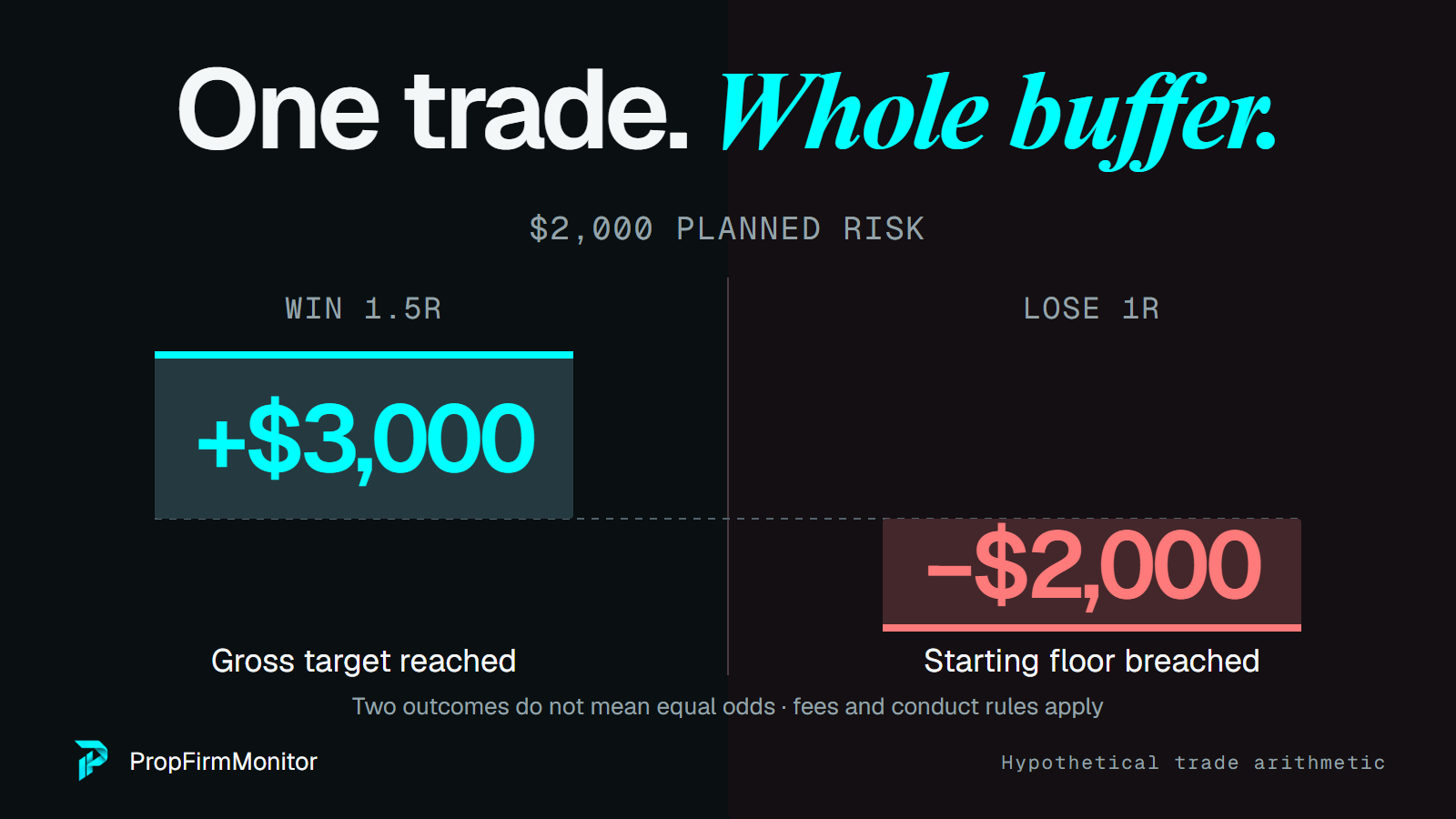
Full port means risking the whole available loss buffer on one trade. For the fresh example, that is $2,000. A 1.5R winner makes $3,000 before costs. A full $2,000 loss reaches $48,000, the starting breach floor. Commissions or slippage can make the floor arrive sooner.
| Planned risk | Outcome | Effect |
|---|---|---|
| $2,000 | Win 1.5R: +$3,000 | Gross target reached; net target and review remain |
| $2,000 | Lose: −$2,000 | Starting loss floor reached; account fails |
Calling this a coin flip describes how much rests on one outcome. It does not mean the trade wins half the time. There is no win-rate evidence in this example, and the reward multiple cannot supply it.
Keep the rules and the habit together
FundedNext permits news trading under its ordinary rules, but warns that stops can slip. It also sets a daily position-close deadline. Check the current trading session before leaving a trade open. Traders in its Disciplined Trader Program face extra restrictions, so this ordinary-plan example does not apply to them unchanged.
- Do not use the firm’s loss floor as a substitute for your stop.
- Do not read an EOD floor as permission to cross it intraday.
- Do not assume no consistency means no daily limit: Blue Guardian Standard, Alpha Zero and Rapid Daily have daily guards.
- Do not take a weaker setup because it is “only an eval.” I still prefer the balanced approach.
Read the full playbook, size comparison and consistency guide. Compare $50K challenges, use the consistency calculator and budget attempts with funding cost. Profiles: FundedNext, Blue Guardian, Alpha Futures.
Count all fees against actual payout cash. The companion math series separates model results from actual firm rules.
Official sources
- FundedNext Futures Rapid Pro evaluation rulesOfficial source · checked
- FundedNext Futures loss-limit calculationOfficial source · checked
- FundedNext Futures prohibited strategiesOfficial source · checked
- FundedNext Futures Disciplined Trader ProgramOfficial source · checked
- FundedNext Futures fees, holding and news rulesOfficial source · checked
- Blue Guardian Futures Standard rulesOfficial source · checked
- Alpha Futures Zero rulesOfficial source · checked
- FundedNext Futures Rapid Daily evaluation rulesOfficial source · checked
- Alpha Futures maximum loss limitOfficial source · checked
This is education, not financial advice. Rules change; check the firm's current terms before you trade.
