Divide the target by the loss limit
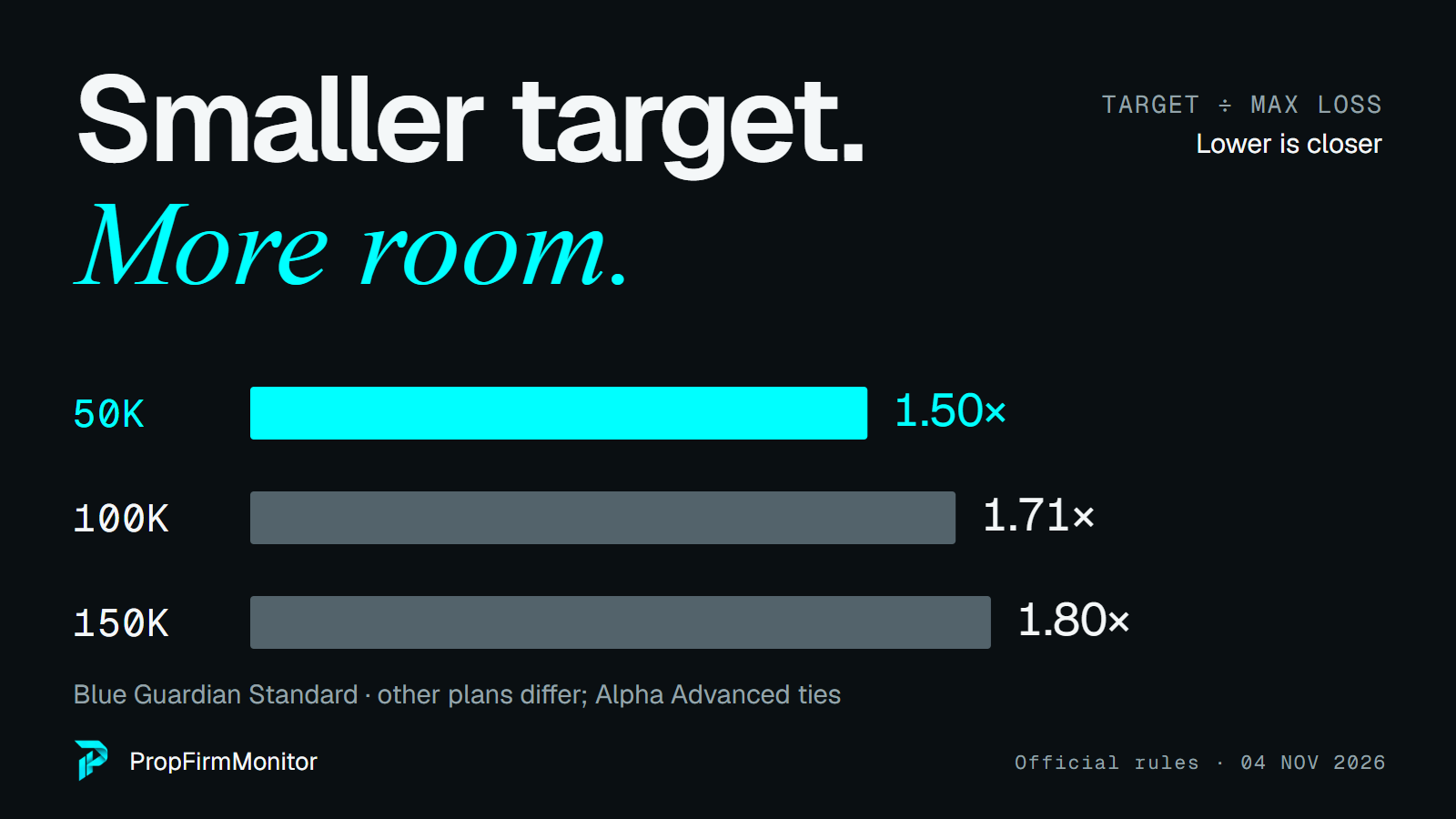
You buy room for losses. A $3,000 target against $2,000 of allowed loss is a 1.50 times ratio, and the larger account label does not always improve that deal.
I like the $50K because the target can be closer relative to the allowed loss. You can see that without comparing contract counts or staring at the largest account label. Take the profit target and divide it by maximum loss. A lower result means less required profit for each dollar of starting buffer.
This is a ratio, not a pass probability. It does not tell you whether your setup wins often enough or whether your risk fits the rules. The numbers below are as of November 2026, checked on 4 November, from the firms' official pages.
Compare the actual dollars across sizes
| Firm and plan | 50K | 100K | 150K |
|---|---|---|---|
| Blue Guardian Standard | $3,000 / $2,000 / 1.50× | $6,000 / $3,500 / 1.71× | $9,000 / $5,000 / 1.80× |
| Blue Guardian Reserve | $3,000 / $2,000 / 1.50× | $6,000 / $3,000 / 2.00× | $9,000 / $4,500 / 2.00× |
| FundedNext Rapid Pro | $3,000 / $2,000 / 1.50× | $5,000 / $2,500 / 2.00× | Not offered |
| FundedNext Flex | $2,500 / $1,500 / 1.67× | $5,000 / $2,500 / 2.00× | $8,000 / $4,000 / 2.00× |
| Alpha Futures Standard | $3,000 / $2,000 / 1.50× | $6,000 / $3,000 / 2.00× | $9,000 / $4,500 / 2.00× |
| Alpha Futures Zero | $3,000 / $2,000 / 1.50× | $6,000 / $3,000 / 2.00× | Not offered |
| Alpha Futures Advanced | $4,000 / $1,750 / 2.29× | $8,000 / $3,500 / 2.29× | $12,000 / $5,250 / 2.29× |
Ratios are rounded to two decimals. The table compares the same plan across its offered sizes. Direct plans skip evaluation, so they do not belong in a comparison of evaluation targets. A missing size is not a zero target. An end-of-day (EOD) trailing floor is the balance line you must stay above. It can rise after a profitable daily close.

Where the $50K case holds up
Blue Guardian Standard gives the $50K the smallest ratio of its listed sizes here. But its larger plans are not both 2.00×. Their current maximum loss allowances make them about 1.71× and 1.80×. Use those current figures when you compare sizes.
FundedNext Flex also favors $50K on this measure, though it has a different target and loss buffer. You cannot copy the $400 passive risk plan onto it and assume the same number of loss slices. Its $50K loss buffer is $1,500, not $2,000.
Alpha Standard and Zero give the familiar 1.50× versus 2.00× comparison. Standard has a 50% evaluation consistency rule. Zero has none in evaluation, but its daily loss guard still applies. Pick the plan before you copy the ratio.
The exception matters: Alpha Advanced is a tie
Alpha Advanced uses a different set of targets and loss allowances. Each listed size has the same unrounded target-to-loss ratio. The $50K is not the best ratio there; it ties the larger sizes at about 2.29×.
That is why I would not turn “I like the $50K” into “the $50K is always best.” My preference fits several real plans. It does not give the smallest account a special advantage when the target and buffer scale together.
Check cost and rules before buying
A lower ratio does not tell you the price of the attempt. Alpha Standard lists $129 a month for $50K before promotions. FundedNext Rapid Pro lists a discounted $149.99 one-time price for $50K without the daily-loss add-on. Those billing models need different budgets.
Use the funding cost tool to compare the billing periods you expect to need. Verify the final price and selected options at checkout. A discount can change the bill and, when tied to an add-on, the rules you receive.
- Do not treat the account label as your risk budget.
- Do not compare one plan’s target with another plan’s larger loss allowance.
- Do not read the initial buffer as fixed room for the whole evaluation; an EOD trailing floor can rise.
- Do not assume a one-day finish from the ratio. Consistency and minimum-day rules still apply.
Next, read the full playbook, consistency examples and full-port maths. Compare $50K challenges and run net figures through the consistency calculator. Firm profiles: Blue Guardian, FundedNext, Alpha Futures.
Compare risk sizes in the seeded model. The companion math series separates model results from actual firm rules.
Official sources
- Blue Guardian Futures Standard rulesOfficial source · checked
- Blue Guardian Futures Reserve rulesOfficial source · checked
- FundedNext Futures Flex evaluation rulesOfficial source · checked
- FundedNext Futures Rapid Pro evaluation rulesOfficial source · checked
- Alpha Futures Standard rulesOfficial source · checked
- Alpha Futures Zero rulesOfficial source · checked
- Alpha Futures Advanced rulesOfficial source · checked
- Alpha Futures pricing and minimum trading daysOfficial source · checked
This is education, not financial advice. Rules change; check the firm's current terms before you trade.
